
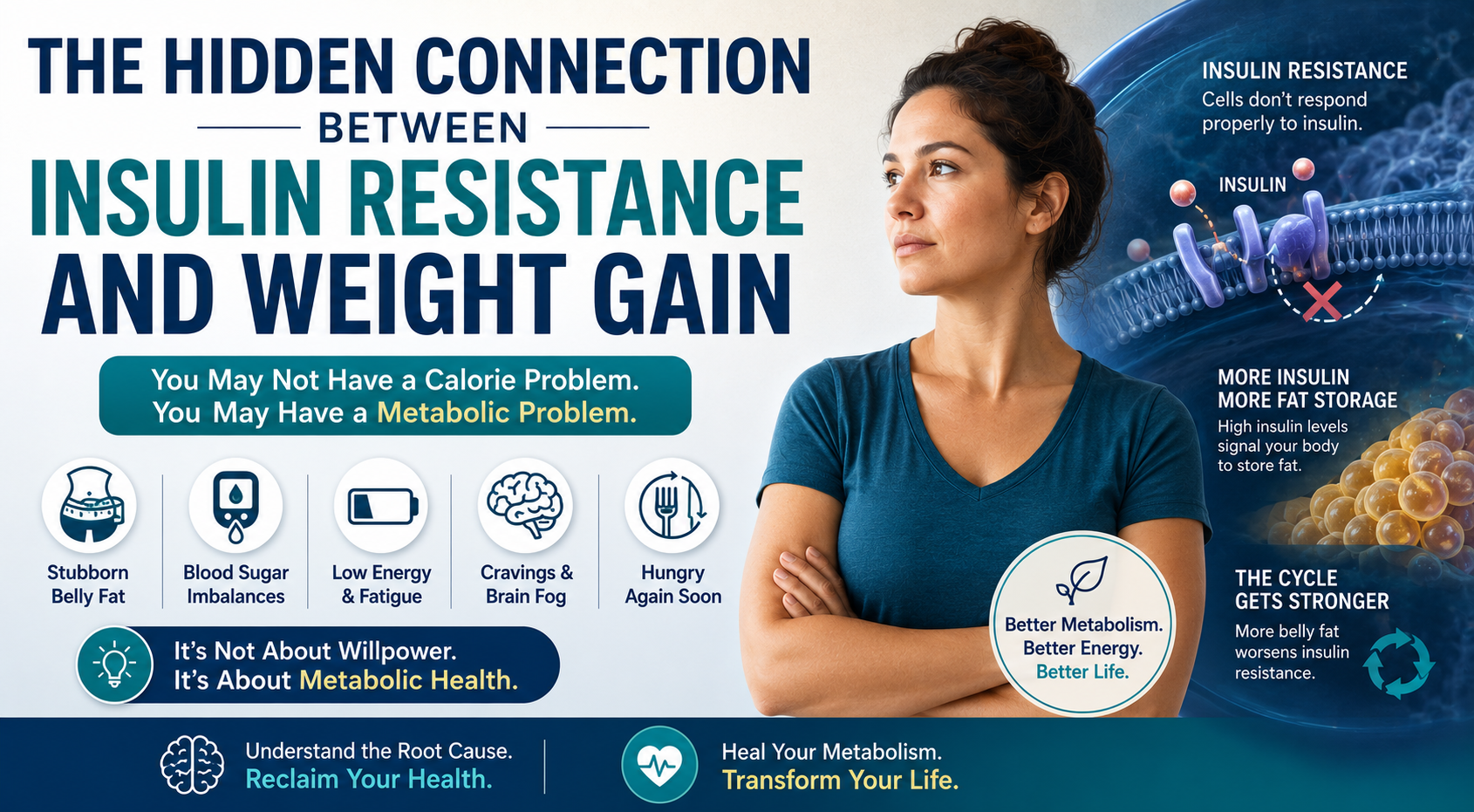
The Hidden Connection Between Insulin Resistance and Weight Gain
You May Not Have a Calorie Problem. You May Have a Metabolic Problem.
For decades people have been given the advice to lose weight.
They are told to eat less and move more.
They are told to count calories and try harder.
Yet millions of people are still gaining weight even though they are making an effort to be healthier.
What if the problem is not that you are not trying hard enough?
What if your body is actually working against you?
This is where insulin resistance comes in.
Insulin resistance is a metabolic condition that affects millions of Americans.
It often goes undiagnosed for years.
Many people who are struggling with weight gain and stubborn belly fat may actually have insulin resistance.
They may feel tired. Have cravings and energy crashes.
They do not realize that insulin resistance is the cause of their problems.
Understanding the connection between insulin resistance and weight gain can completely change the way you think about losing weight and being healthy.
What Is Insulin Resistance?
Insulin is a hormone that helps your body use sugar for energy.
It is produced by the pancreas.
In a healthy body, insulin works well.
Over time, your body's cells can become less responsive to insulin.
This is called insulin resistance.
When this happens, your body produces more insulin.
As a result, you have high insulin levels in your body for a long time.
Most people focus on blood sugar levels.
Few people realize that insulin itself can cause your body to store fat.
Insulin is one of the most powerful fat-storage hormones in your body.
Why Weight Gain Often Starts Before Blood Sugar Problems
Many people think that insulin resistance only matters if you have diabetes. That is not true.
Weight gain often starts years before your blood sugar levels become abnormal.
Many people are told that their glucose numbers are normal, but their insulin levels are still rising.
This creates a metabolic environment that makes it hard to lose weight.
Your body becomes better at storing energy and worse at using stored fat for fuel.
This means that two people can eat the same food and exercise in the same way, yet they can have very different results when it comes to losing weight.
The difference is not about calories. The difference is about metabolic health.
Insulin resistance is a major part of metabolic health.
The Hidden Symptoms Many People Ignore
Insulin resistance does not always have obvious symptoms. It can appear as a collection of symptoms that seem completely unrelated.
These symptoms can include:
- Persistent weight gain
- Difficulty losing weight
- Increased belly fat
- Strong cravings for carbohydrates
- Energy crashes in the afternoon
- Brain fog
- Increased hunger after eating
- Fatigue despite getting enough sleep
- Difficulty feeling full after meals
Many people think that these symptoms are just a part of getting older. They can actually be early warning signs of deeper metabolic problems.
Why Belly Fat Is Different
Not all body fat is the same.
Visceral fat, or belly fat, is different.
It surrounds your organs and is highly metabolically active.
This type of fat can release compounds that make insulin resistance even worse.
The relationship between insulin resistance and belly fat is cyclical:
Insulin resistance causes your body to store more fat. The more belly fat you have, the worse your insulin resistance becomes.
This is why some people gain weight even though they are doing everything they can to be healthy. The underlying metabolic issue is simply not being addressed.
The Energy Crisis Happening Inside Your Cells
One of the least discussed aspects of insulin resistance is energy production.
Many people think that if they have excess weight, they must have excess energy. That is not always true.
When your cells are not responding properly to insulin, your body has trouble delivering energy effectively.
You may feel tired and sluggish even though you have excess body fat. This is because your body is continuously storing energy but not using it efficiently.
Why Willpower Is Often Blamed Unfairly
Insulin resistance can have a heavy impact on your mental health.
People often blame themselves for their weight gain. They think they lack motivation or discipline. That is not always the case.
Biological signals can strongly influence your hunger, cravings, and thoughts about food.
When your metabolic pathways are disrupted, your appetite regulation can change dramatically.
This is not just about self-control. It is about your physiology.
Modern obesity medicine is starting to recognize that weight management is not purely about willpower. It is about hormones, brain signaling, metabolism, genetics, and environmental factors.
How GLP-1 and Tirzepatide Are Changing the Conversation
Recent advances in obesity medicine have completely changed the way healthcare providers approach metabolic health.
GLP-1 medications help regulate appetite and improve blood sugar regulation.
Tirzepatide targets both GLP-1 and GIP pathways. This has generated a lot of attention because it addresses multiple metabolic processes at the same time.
Many patients have reported a massive reduction in food thoughts, cravings, and hunger signals.
For many people, this is the first time they realize that their struggle with weight gain was not just a lack of effort. It was a clear metabolic challenge.
The Future of Weight Loss Is Metabolic Health
The conversation around obesity is changing rapidly.
Experts are starting to view weight as a complex, chronic condition influenced by metabolic health, hormonal regulation, inflammation, genetics, sleep quality, stress, and lifestyle factors.
The goal is no longer just to lose weight. The goal is to improve overall metabolic function.
When metabolic health improves, many other aspects of health often improve too. Energy levels rise, blood sugar becomes more stable, and inflammation may decrease. Mobility and quality of life often improve dramatically.
Final Thoughts
If you have struggled with weight gain despite trying to eat less and exercise more, it may be worth looking beyond calories alone.
Insulin resistance is one of the most overlooked drivers of modern weight gain.
Understanding it can shift the entire conversation from blame to biology.
That shift matters immensely.
Because when people understand the role of metabolic health, they stop asking, "What's wrong with me?"
And they start asking a far more productive question:
"What is my body trying to tell me?"
