
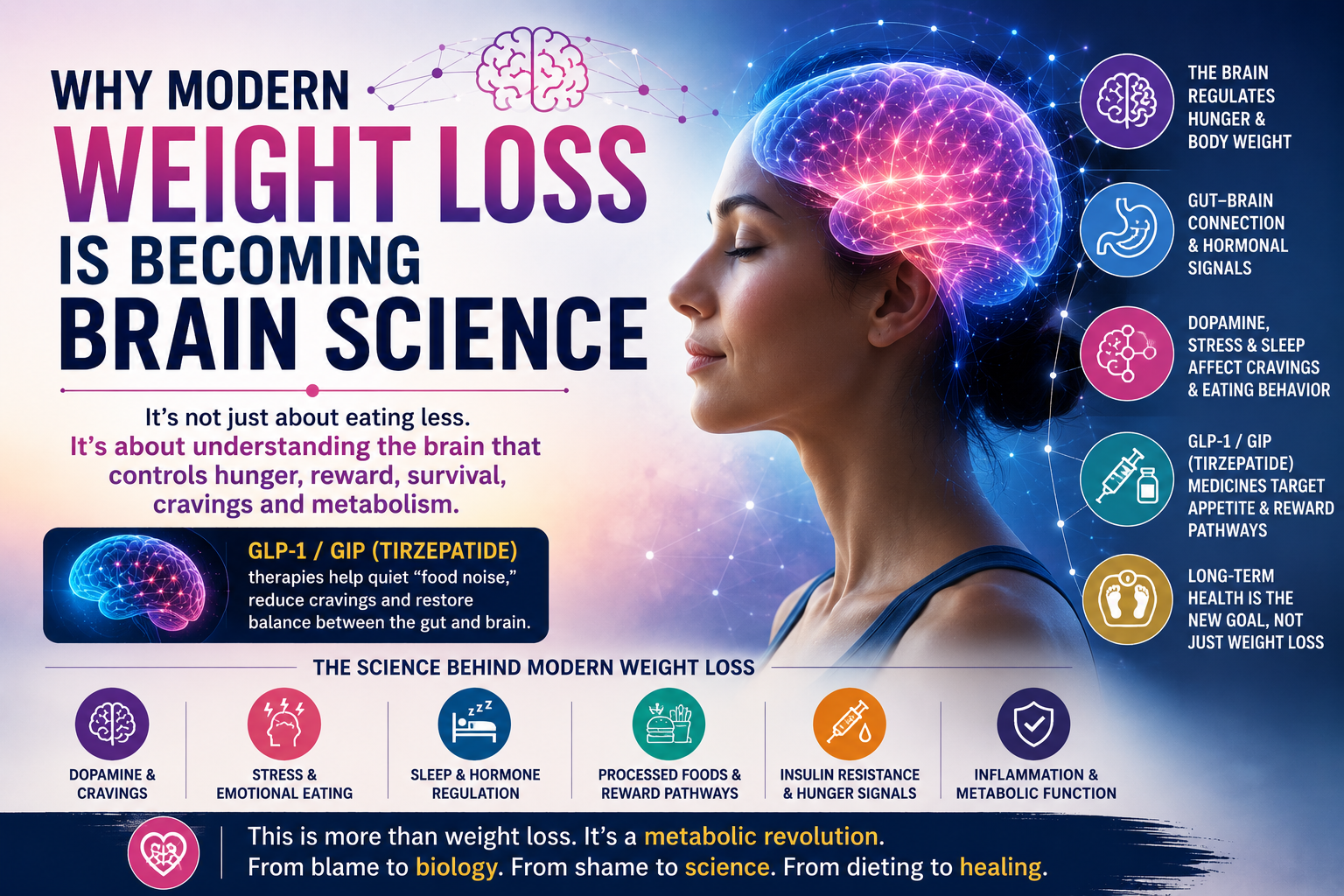
Why Modern Weight Loss Is Becoming Brain Science
For a time people thought losing weight was all about the body.
Calories.
Exercise.
Meal plans.
Portion control.
Now doctors are focusing on something more important:
the brain.
Researchers studying obesity, medicines that help with weight loss and long-term weight control are finding that many reasons for overeating cravings and weight gain come from the brain not just behavior.
This new understanding is changing how we treat weight loss.
Hunger isn't about feeling full.
It involves the brain's reward systems, survival pathways, hormonal signals, stress responses and dopamine.
This explains why many smart motivated people struggle to lose weight despite trying diets. Traditional diets treated weight loss as a choice ignoring the biological processes at work.
The brain plays a role in regulating body weight.
When you eat less and lose fat your brain sees this as a threat to survival. Your body may increase hunger hormones make you crave food slow down your metabolism and make you feel less full to regain lost weight.
This process, called metabolic adaptation helps explain why many people gain weight back after dieting.
Many people thought they just weren't disciplined enough.
Their brain was actually trying to protect them.
This new understanding has led to changes in obesity medicine. Modern treatments focus on the connection between the gut and brain hormonal signals and neurological pathways.
GLP-1 / GIP (Tirzepatide) medicines like semaglutide and tirzepatide have changed the conversation.
These treatments target pathways that control appetite, insulin sensitivity and signaling between the gut and brain. Patients and researchers have noticed the effects of these treatments.
The "food noise" quiets down.
Patients often say they no longer spend their days battling cravings. The sense of urgency around food diminishes. Emotional eating urges lessen. Some describe finally having a healthier relationship with food.
This has become one of the most discussed aspects of modern GLP-1 / GIP (Tirzepatide) weight loss treatment.
It shows that many people struggling with obesity were dealing with more than hunger.
They were dealing with reward circuitry, stress responses, hormonal imbalances and biological systems that defend body weight.
This is why modern weight loss is becoming closely linked to neuroscience.
Researchers are now studying:
- how dopamine affects cravings
- why stress boosts emotional eating
- how trauma may impact food choices
- why poor sleep disrupts appetite regulation
- how highly processed foods overstimulate reward pathways
- why insulin resistance alters hunger signals
- how inflammation may influence metabolic function
The science is evolving beyond diet culture.
This new understanding helps patients emotionally and physically.
Once people realize their struggles aren't about weakness years of shame can lift. Many finally understand why "just eat less" was never easy.
Their biology may have been pushing back all along.
This insight is also changing how sustainable weight loss programs are designed. Modern obesity specialists focus on muscle preservation, protein intake, metabolic flexibility sleep improvement, stress management, hormonal balance and long-term metabolic health.
The goal is no longer to lose weight temporarily.
The goal is to rewire long-term metabolic function and create lasting changes.
One of the most fascinating aspects of this metabolic revolution is that researchers are only beginning to understand how strongly the brain affects obesity and chronic disease.
Some experts believe future obesity treatments may become even more personalized through brain-based metabolic profiling.
In many ways the future of healthcare is shifting from punishment to understanding the biological systems that drive human behavior.
For millions struggling with weight this change could be life-altering.
Modern weight loss is no longer about eating less.
It's about understanding the brain that controls hunger, reward, survival, cravings and metabolism.
