
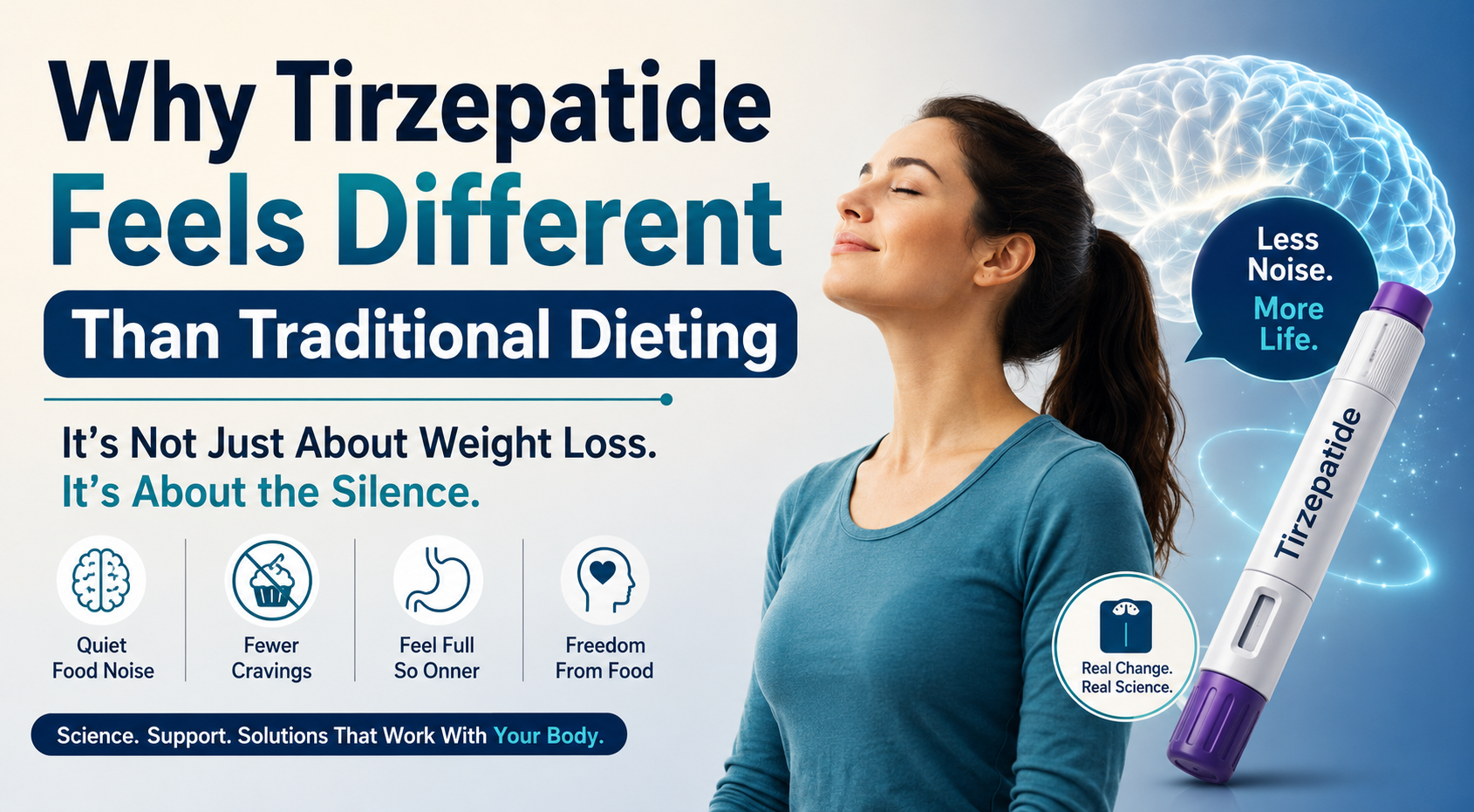
Why Tirzepatide Feels Different Than Traditional Dieting
For patients, the biggest surprise isn't the weight loss. It's the silence.
For decades, weight loss advice has been the same.
- Eat less
- Move more
- Try harder
- Stay disciplined
But millions of people have followed those instructions only to find themselves stuck in a cycle of losing weight, regaining it, and blaming themselves.
What if the problem was never a lack of willpower?
What if the real challenge was something happening inside the brain and body that most people never knew existed?
This is one reason why many patients describe their experience with Tirzepatide as fundamentally different from traditional dieting.
The common comment isn't always about the number on the scale. It's about the quiet.
Many patients say that for the first time in years, thoughts about food start to fade.
The urge to snack weakens.
The endless internal negotiations disappear.
Suddenly, managing food no longer feels like a full-time job.
Understanding Food Noise
There's an idea in obesity medicine called "food noise."
Food noise refers to the thoughts about food:
- Thinking about your next meal while finishing your current one
- Constant cravings
- Repeated urges to snack
- Feeling distracted by thoughts of food throughout the day
Many people assume everyone experiences food the same way. They don't.
Research shows that hunger, cravings, and appetite are heavily influenced by biology, hormones, metabolism, and brain signaling pathways.
For individuals struggling with obesity or excess weight, food noise can become overwhelming.
This isn't a character flaw. It's often a biological reality.
Tirzepatide may help quiet that noise by working with pathways involved in hunger and fullness.
Why Traditional Dieting Often Feels Like A Constant Battle
Traditional dieting usually focuses on restriction.
- Eat fewer calories
- Avoid certain foods
- Ignore cravings
- Fight hunger
The problem is that the human body doesn't always cooperate.
When calorie intake drops significantly, the body often activates survival mechanisms.
- Hunger hormones may increase
- Metabolism may slow
- Cravings can intensify
- Energy levels may decline
This is one reason many people initially lose weight but struggle to keep that weight off long-term.
The body frequently interprets dieting as a threat and responds by pushing back.
As a result, many individuals spend years battling their biology.
How Tirzepatide Works Differently
Tirzepatide represents a newer approach to medical weight loss.
Rather than relying solely on willpower, it targets biological systems involved in appetite regulation and metabolic health.
Tirzepatide works by activating both GLP-1 and GIP receptors, two important hormone pathways involved in hunger control, blood sugar regulation, digestion, and fullness.
These pathways help the brain and body communicate effectively about energy intake and satiety.
Many patients report:
- Reduced hunger
- Fewer cravings
- Greater satisfaction after meals
- Less interest in overeating
- Improved portion control
- Reduced emotional eating triggers
Instead of constantly resisting food, many people simply feel less driven by it.
That difference can be life-changing.
The Brain Plays A Bigger Role Than Most People Realize
Modern obesity research points to the brain as a major player in weight regulation.
The brain constantly processes signals related to hunger, reward, energy needs, and satisfaction.
When these systems become disrupted, eating behaviors can become hard to control despite genuine effort.
This helps explain why some people can walk past a plate of cookies without thinking twice, while others have intense cravings.
The difference isn't necessarily motivation. The difference is often biology.
Tirzepatide seems to influence some of these brain pathways, helping lower the intensity of hunger signals and reward-driven food behaviors.
For patients, the result feels surprisingly natural.
They're not forcing themselves to eat less. They simply want less.
Why Willpower Often Fails
Perhaps one of the most important lessons from modern obesity medicine is this:
Willpower is not a long-term fix for biology.
Most people would never tell someone with asthma to breathe harder.
They wouldn't tell someone with high blood pressure to just try harder.
Yet for years, obesity was often viewed solely as a matter of personal responsibility.
Today, science reveals a more complex picture. Many factors affect body weight, including:
- Genetics
- Hormones
- Insulin resistance
- Metabolism
- Inflammation
- Sleep quality
- Stress levels
- Brain chemistry
This doesn't mean healthy habits don't matter. They absolutely do.
Expecting willpower alone to overcome strong biological signals can lead to unnecessary frustration and guilt.
Medical weight loss treatments like Tirzepatide are helping shift that conversation toward an evidence-based understanding of obesity and metabolic health.
More Than Weight Loss
The conversation around Tirzepatide often focuses on pounds lost.
While weight reduction matters, many patients describe something more meaningful.
Freedom.
- Freedom from cravings
- Freedom from obsessive thoughts about food
- Freedom from feeling like every day is a battle
For some, that psychological relief is just as valuable as the physical change.
As obesity medicine continues to evolve, the future of weight management is becoming less about punishment and restriction and more about understanding the biology that drives behavior.
Because for many people, the greatest breakthrough isn't seeing a smaller number on the scale.
It's finally experiencing what life feels like when food is no longer controlling the conversation.
