
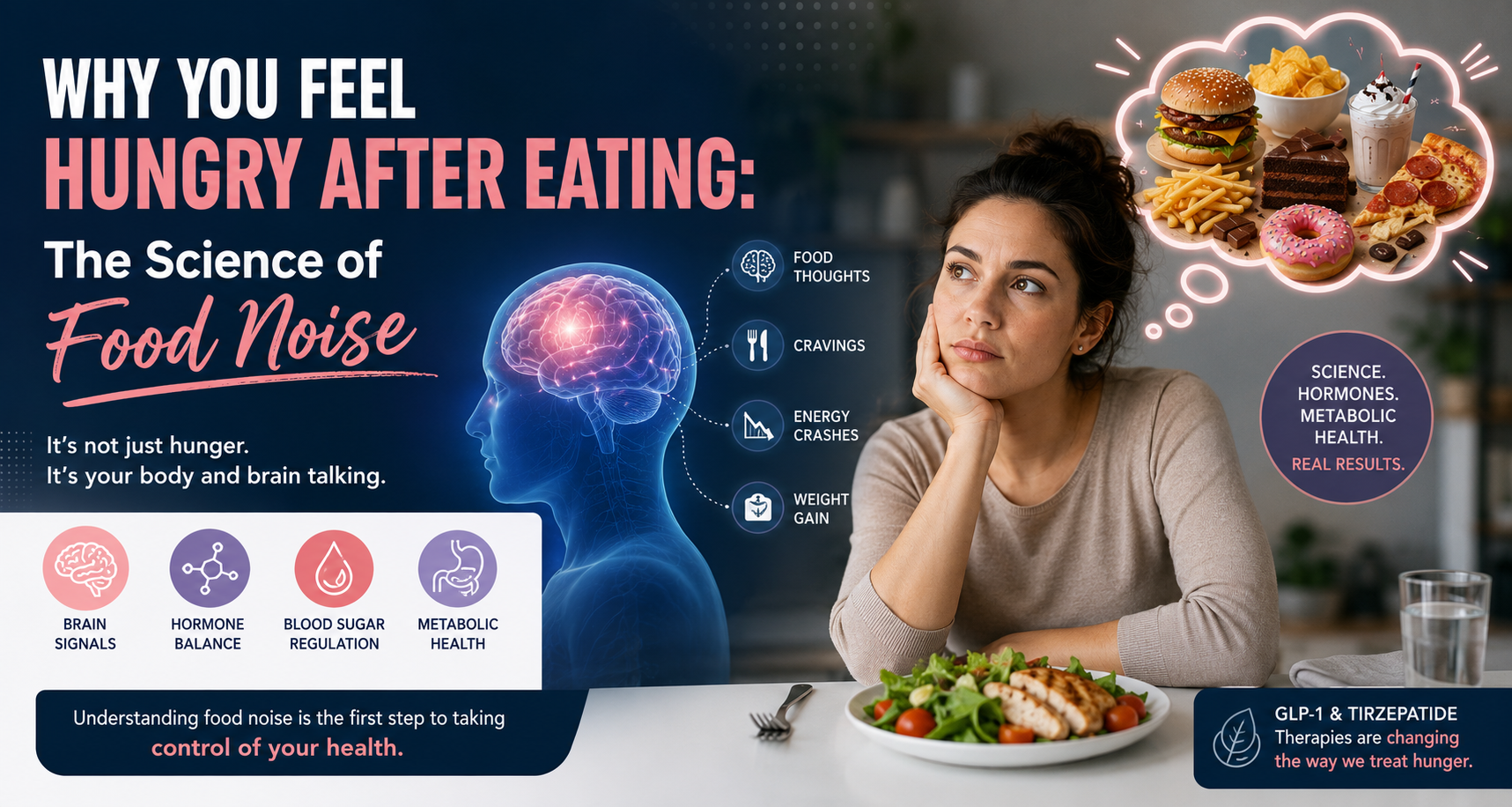
Why You Feel Hungry After Eating: The Science of Food Noise
Your Stomach May Be Full. Your Brain May Be Asking for More.
Have you ever finished a meal and found yourself thinking about food again an hour later?
Maybe you were not physically hungry.
Maybe your stomach felt full.
Yet somehow your mind kept drifting toward snacks, dessert, or your next meal.
If this sounds familiar, you are not alone.
Millions of people experience this every day.
Many assume it means they lack discipline.
Others think they simply need more willpower.
But there may be something much deeper happening.
Experts increasingly refer to this experience as food noise.
Food noise is the constant stream of thoughts about food that can run in the background of your mind throughout the day.
Understanding food noise may completely change how you think about hunger, cravings, metabolism, and weight loss.
What Is Food Noise?
Food noise is not simply hunger.
It is the mental chatter surrounding food.
Many people describe it as constantly thinking about eating even when they are not physically hungry.
Food noise can look like:
- Thinking about your next meal all day
- Feeling unsatisfied after eating
- Constant cravings for snacks or sweets
- Planning food around every activity
- Feeling distracted by thoughts about food
- Struggling to stop thinking about eating
What surprises many people is that not everyone experiences food noise.
Some individuals eat, feel satisfied, and move on with their day.
Others spend hours mentally negotiating with themselves about food.
Food noise is not always a sign of hunger. It can be a sign that the body's appetite regulation system is sending stronger signals than necessary.
Your Brain Controls Hunger More Than Your Stomach
Most people assume hunger begins in the stomach.
Modern research tells a different story.
The brain plays a major role in regulating hunger, fullness, cravings, and eating behavior.
Your body constantly sends signals between the digestive system and the brain.
These signals help determine:
- When you feel hungry
- When you feel full
- How satisfied you feel after eating
- How often you think about food
When these signals function properly, eating feels relatively effortless.
When they become disrupted, food noise can become louder and harder to ignore.
Why Some People Feel Hungry All the Time
Many people wonder why they seem hungry all day long.
The answer is often more complicated than simply needing more food.
Hormones help regulate appetite and communicate energy needs to the brain.
When these pathways become less efficient, people may experience:
- Frequent hunger
- Increased cravings
- Constant snacking
- Difficulty feeling full
- Persistent thoughts about food
This creates a frustrating cycle.
The more food noise someone experiences, the more likely they are to believe they simply need stronger willpower.
In reality, biology may be playing a significant role.
The Hidden Link Between Insulin Resistance and Food Noise
One of the most overlooked contributors to food noise is insulin resistance.
Insulin is a hormone responsible for helping move glucose into cells where it can be used for energy.
When cells become less responsive to insulin, blood sugar regulation can become unstable.
This may contribute to:
- Energy crashes
- Increased hunger
- Sugar cravings
- Fatigue
- Difficulty losing weight
Many individuals with insulin resistance report feeling as though food is constantly on their minds.
Even after eating, they may continue searching for something else to satisfy them.
For many people, the problem is not a lack of effort. It is a metabolic signal that never seems to turn off.
Why Cravings Are Not Just About Willpower
Society often treats cravings as a personal failure.
The science suggests otherwise.
Appetite is influenced by hormones, brain chemistry, metabolic health, sleep quality, stress levels, and genetics.
When these systems become imbalanced, cravings can become stronger and more frequent.
This helps explain why traditional diets often fail.
The issue is not usually a lack of knowledge.
Most people already know which foods are healthy.
The challenge is managing the biological signals driving behavior every day.
How GLP-1 and Tirzepatide Are Changing Weight Management
Recent advances in obesity medicine are changing the conversation around appetite regulation.
GLP-1 therapies help regulate hunger, improve satiety, and support healthier blood sugar control.
Tirzepatide goes a step further by targeting both GLP-1 and GIP pathways.
Many patients report something unexpected.
Not just weight loss.
Silence.
They often describe a dramatic reduction in food noise.
For the first time in years, thoughts about food no longer dominate their day.
This mental shift can be one of the most meaningful benefits patients experience.
The Future of Weight Loss Is Understanding the Brain
One of the biggest discoveries in modern obesity medicine is that weight management is not simply about eating less.
The brain, hormones, metabolism, and appetite pathways all work together.
When those systems become healthier:
- Cravings often decrease
- Hunger becomes easier to manage
- Food noise becomes quieter
- Healthy choices feel more natural
This shift can improve not only weight management but also confidence, energy, and overall quality of life.
Health Is About More Than the Scale
Weight is only one part of the health picture.
Improving metabolic health may also support better energy levels, healthier blood sugar regulation, improved mobility, and a stronger sense of well-being.
Understanding food noise helps people see that hunger is not always about an empty stomach.
Sometimes it is about the signals coming from the brain and metabolism.
Final Thoughts
If you have ever wondered why you feel hungry after eating, food noise may be part of the answer.
Food noise is a real experience that affects millions of people and is often influenced by biology, hormones, and metabolic health.
Understanding these signals can help explain why cravings occur, why weight loss can feel difficult, and why modern obesity medicine is shifting its focus toward appetite regulation.
Sometimes the most powerful step in a health journey is not eating less.
It is finally understanding why your body keeps asking for more.
